
Molecular Biology of Insect Signal Transduction Cascades
#signalingininsects
Description
We established a strong collabration with the Laboratory of Insect Evolutionary Molecular Biology to investigate insect chemoreception and signaling at the biochemical and structural level. Our methods for recombinant protein production proved highly suitable for these investigations and we are currently exploring how the broad diversity in protein sequences and architectures correlates with specific insect physiological functions.
In this context, Aedes albopictus LIPS-2 was identified as a salivary factor controlling probing in Aedes mosquitoes prior to blood feeding. We carried out a comprehensive and multidisciplinary investigation around this protein, including its three-dimensional structure which revealed a novel fold (figure A). This characterization ultimately yielded a model of the role of LIPS-2 during blood feeding. In this model mosquitoes start salivating when they press the proboscis on the skin surface (figure B, left panel), since the saliva is deposited on the surface of the membrane during bite-blot experiments. LIPS-2 in the saliva binds the CP19 at the tip of the labrum and this causes a change in the morphology of the V-shaped ridges, enhancing their depth (figure B, central panel). Finally, this change is sensed by mosquitoes, and it causes further salivation and the beginning of the intradermal probing (figure B, right panel), facilitating blood vessel location. The labrum is shown in orange, the hypopharynx carrying the salivary duct and its opening at the tip in violet, maxillae in green. The V-shaped ridges are shown as black line after stimulation.
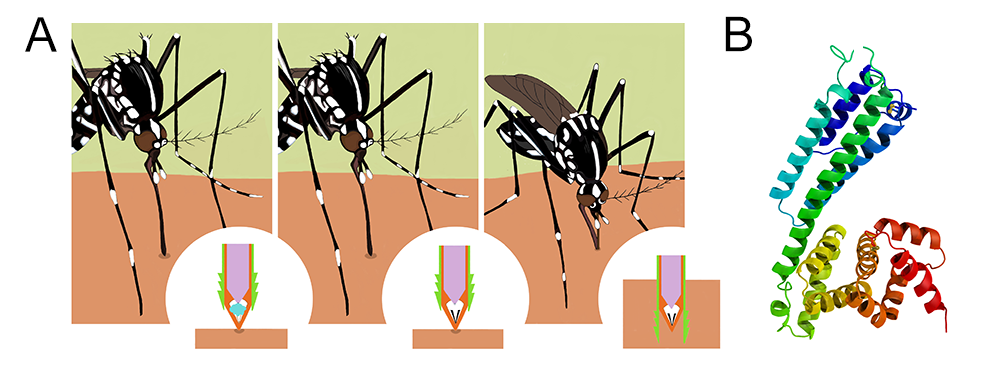 |
Mosquitoes start salivating when they press their proboscis on the skin surface (A, left panel). LIPS-2 in the saliva (B, shown as a cartoon) binds Cp19 at the tip of the labrum, causing a change in the morphology of the V-shaped ridges and increasing their depth (A, central panel). Finally, this change is sensed by mosquitoes, causing further salivation and the beginning of intradermal probing (A, right panel), thereby facilitating blood-vessel location. |
Resources
PDB Files:
- 7TDS – Crystal structure of LIPS-2 (Native data)
- 7TDR – Crystal structure of LIPS-2 (Se-Met data)
- 6HHE – Crystal structure of CcapOBP22/CcapOBP69a
SASBDB Files:
- SASDJX7 – Labrum-Interacting Proteins from Saliva 2 (34k-2) measured using SEC-SAXS
Companion files are available in our data repository.
Publications and Dissemination
Publications
- Berlinguer M., Sadeghichehelgaz M., Vetrano A., D’Aquilio A., Mercuri F., Villa M., Gabrieli P., Iacobucci C., Forneris F. Structural studies of the C-terminal cysteine-rich domain of Aedes albopictus vitellogenin reveal an evolutionarily divergent, monomeric C-terminal cysteine knot (CTCK) architecture. bioRxiv 2026.05.25.727680 (2026).
- Arnoldi I., Villa M., Mancini G., Varotto-Boccazzi I., Yacoub M.R., Asperti C., Mascheri A., Casiraghi S., Epis S., Bandi C., Dagna L., Forneris F., Gabrieli P. IgE response to Aed al 13 and Aed al 14 recombinant allergens from Aedes albopictus saliva in humans. World Allergy Organization Journal 16, 100836 (2023). – PubMed – UNIFIND
- Arnoldi I., Mancini G., Fumagalli M., Gastaldi D., D’Andrea L., Bandi C., Di Venere M., Iadarola P., Forneris F., Gabrieli P. A salivary factor binds a cuticular protein and modulates biting by inducing morphological changes in the mosquito labrum. Current Biology 32, 1–12 (2022). – PubMed – UNIFIND
- Buezo Montero S., Gabrieli P., Montarsi F., Borean A., Capelli S., De Silvestro G., Forneris F., Pombi M., Breda A., Capelli G., Arcà B. IgG Antibody Responses to the Aedes albopictus 34k2 Salivary Protein as Novel Candidate Marker of Human Exposure to the Tiger Mosquito. Frontiers in Cellular and Infection Microbiology 10, 377 (2020). – PubMed – UNIFIND
- Buezo Montero S., Gabrieli P., Severini F., Picci L., Di Luca M., Forneris F., Facchinelli L., Ponzi M., Lombardo F., Arcà B. Analysis in a murine model points to IgG responses against the 34k2 salivary proteins from Aedes albopictus and Aedes aegypti as novel promising candidate markers of host exposure to Aedes mosquitoes. PLoS Neglected Tropical Diseases 13, e0007806 (2019). – PubMed – UNIFIND
- Falchetto M.*, Ciossani G.*, Scolari F., Di Cosimo A., Nenci S., Field L.M., Mattevi A., Zhou J.-J., Gasperi G., Forneris F. (*Equal contribution). Structural and biochemical evaluation of Ceratitis capitata OBP22 affinity for odorants involved in inter-sex communication. Insect Molecular Biology 28, 431–443 (2019). – PubMed
Press Releases
- Joint UniMI–UniPV–Armenise Harvard Foundation press release concerning Arnoldi, Mancini et al., Current Biology (2022) – PDF in Italian
Media Coverage
- Studentessa di Sulmona scopre il segreto delle zanzare (Il Messaggero, 18-07-2022) – PDF excerpt
- Come neutralizzare le zanzare: la scoperta scientifica di Giulia (Il Germe, 16-07-2022)
- Zanzare, scoperto il meccanismo che fa irrigidire il “pungiglione” (SkyTG24, 14-07-2022)
- Ecco come si potrà “spegnere” il pungiglione delle zanzare (Il Giornale, 14-07-2022)
- Le punture di zanzare provocate da una proteina (Corriere della Sera Milano, 14-07-2022) – PDF excerpt
- Zanzare, stop punture “spegnendo” la proteina che fa irrigidire il pungiglione (Il Secolo XIX, 13-07-2022)
- “Ecco come rendere innocue le zanzare”. Lo studio targato Pavia su una proteina (La Provincia Pavese, 13-07-2022) – PDF excerpt – PDF excerpt 2
- Zanzare, stop punture “spegnendo” la proteina che fa irrigidire il pungiglione (La Repubblica, 13-07-2022) – PDF excerpt